


Workplace Fatalities Fall for Second Year in a Row
Do you fear for your life each day when you head to work? No, this isn’t a joke with Monday or your boss as the punch line. Thousands of people die each year due to injuries suffered on the job. Do you have the type of job with inherent safety risks?
Some jobs obviously tend to be more dangerous than others. Lion tamers and offshore oil rig workers jump to mind. However, the millions of people who work in modern manufacturing facilities can also find themselves surrounded by equipment that can kill if not handled properly.
For example, workers maintaining equipment can be seriously injured from the unexpected energization of, release of stored energy from, or startup of equipment. That’s why mandatory safety training, such as those related to lock-out/tag-out procedures, is so critical.
Lock-out/tag-out rules establish standards for the shutdown of equipment, so that energy sources can be isolated to prevent the release of potentially hazardous energy during routine maintenance activities. Following proper lock-out/tag-out procedures helps workers to avoid preventable workplace accidents and injuries.
Fortunately, it appears that a focus on safety training nationwide is working. A recent EHS Today article reports that “[t]he U.S. Bureau of Labor Statistics’ [BLS] 2024 fatal occupational injuries data showed 5,070 worker deaths – a second consecutive year of decline.”
NSC CEO Lorraine Martin claims that “[t]his progress shows that when employers focus on serious injury and fatality risks, invest in prevention and build strong safety cultures, lives are protected.” However, she believes that “5,070 deaths in a single year is still 5,070 too many. We must accelerate proven strategies that address the highest-risk exposures and ensure every worker gets home safe.”
To put these statistics in perspective, BLS data shows:
- “The fatal work injury rate was 3.3 fatalities per 100,000 full-time equivalent (FTE) workers in 2024, a decrease from a rate of 3.5 in 2023.”
- “A worker died every 104 minutes from a work-related injury in 2024 compared to 99 minutes in 2023.”
- “Workers in transportation and material moving occupations represented the occupational group with the most fatalities with 1,391 fatal work injuries in 2024, though this was a 7% decrease from 2023 (1,495).”
How can manufacturers get the total of workplace fatalities down to zero? There’s simply no substitute for thorough, effective safety training for every worker before setting foot on the shop floor. For manufacturers without significant experience setting up a safety training program, it can help to partner with established companies to provide industrial-quality training systems that will stand the test of time.
For example, DAC Worldwide offers two safety training systems specifically designed to give employees the hands-on experience they need to master lock-out/tag-out skills:
- DAC Worldwide Lock-Out/Tag-Out Training System
- DAC Worldwide Electrical Lock-Out/Tag-Out Training System
Be sure to check out these training systems and contact a DAC Worldwide representative to learn how you can improve your training today!
- Published in News
Do You Know the Three Layers of Effective Safety Training?
It’s no secret that the U.S. manufacturing industry faces an ongoing “skills gap” issue that is leaving hundreds of thousands of jobs open because there are simply not enough skilled workers to fill them. As experts have sought to understand the factors causing the skills gap, they’ve learned that a persistent negative impression of manufacturing lingers amongst today’s youth.
Although many, if not most, modern manufacturing facilities are clean, comfortable marvels filled with advanced automation technologies, many younger people still think of “factory work” as uncomfortable, dirty, and potentially dangerous. Changing their minds has been at the forefront of efforts to combat the ongoing skills gap.
For sure, there are still factories out there that can be hot and uncomfortable. Some industries simply can’t maintain a clean appearance given the very nature of what they produce. And the potential for danger exists in any facility using large machinery powered by electricity, hydraulics, and pneumatics.
Safety concerns are certainly valid, and they can be relevant to a discussion of any potential industry job. To ease the minds of potential workers—not to mention current workers—today’s manufacturers can take positive steps to ensure that their workplaces are as safe as possible. Doing so not only improves recruiting and morale, but it insulates workers and the manufacturers themselves from the negative effects of workplace injuries.
In a recent EHS Today article, author Rick Tobin outlines “three layers of safety training—task performance, hazard awareness, and engineering solutions,” which he believes are “essential for comprehensive risk reduction.”
Tobin notes that “[r]eactive safety measures focus on treating injuries after they occur…[they] treat symptoms but fail to eliminate systemic hazards, leading to recurring issues.” Instead, he argues that “upstream strategies aim to eliminate hazards at their source…[by] focus[ing] on redesigning systems and processes to prevent accidents before they occur.”
According to Tobin, “[t]he first layer of safety training is the foundation—teaching workers how to perform the job itself with skill and consistency…When you train employees to perform a task correctly—whether it’s operating a forklift, wiring a panel, or handling a chemical—you remove confusion, improvisation, and guesswork.”
That’s why it’s crucial that manufacturers hire workers with the hands-on skills they need to succeed in the workplace. On-site training is also important to ensure that workers understand what is expected of them. Simply put, proper education and training pours a solid foundation that can be built upon to increase workplace safety.
That’s where layer two comes in: “[o]nce workers know how to perform their jobs, the next step is to teach them why it must be done safely—what hazards exist, and what standards govern their prevention. This second layer is about awareness and compliance: understanding the invisible forces that turn ordinary work into extraordinary risk.”
Tobin points out that “[h]azard recognition training transforms workers from task performers into observers and thinkers. They learn to spot the frayed wire before it arcs, the unstable stack before it falls, the fatigue in a coworker before it leads to a mistake. When safety training includes this second layer, employees begin to internalize a new habit of thinking: What could go wrong here, and what’s my role in preventing it?”
If employers can successfully implement this second layer, they’ll notice that “[t]hat mental shift is transformative. It turns safety from a set of rules into a shared mindset.” It also helps with compliance. “OSHA, PPE selection, lockout/tagout—these are some of the legal and procedural anchors of safe behavior. But compliance works best when people understand its logic. Instead of obeying out of fear of penalties, workers comply out of respect for the system that keeps them alive.”
Finally, the last layer is “training workers to think like engineers.” “If the first layer is about doing, and the second is about seeing, the third layer is about solving. This is where workers learn to think critically and design hazards out of existence.”
This might sound beyond the capabilities of many organizations, but Tobin argues that “it’s the single most powerful form of prevention. It moves safety from reaction to innovation.” And who better to suggest effective solutions than the people intimately involved in the very tasks at issue?
Tobin points out that the sequence of these layers of safety training is equally important: “First, teach the task. You can’t be safe doing something you don’t yet know how to do. Second, teach the hazards. Once the job is understood, risks become visible and relevant. Third, teach the solutions. Once workers see risks, empower them to redesign the work.”
According to Tobin, “when all three layers align—knowledge, awareness and innovation—the payoff compounds.” What are those compounding benefits? To name just a few, Tobin points out that employers can expect:
- Reduced Injuries and Illness
- Lower Workers’ Compensation Premiums
- Higher Productivity
- Operational Efficiency
For those wondering how to go about this approach from a practical perspective, Tobin points out that “[m]odern technology now makes it possible to integrate all three layers seamlessly. Online and mobile safety training platforms turn what used to be fragmented, time-consuming initiatives into connected systems of learning and measurement.”
It can also help to partner with established companies to provide industrial-quality training systems that will stand the test of time. For example, DAC Worldwide offers two safety training systems specifically designed to give employees the hands-on experience they need to master lock-out/tag-out skills:
- DAC Worldwide Lock-Out/Tag-Out Training System
- DAC Worldwide Electrical Lock-Out/Tag-Out Training System
Be sure to check out these training systems and contact a DAC Worldwide representative to learn how you can improve your training today!
- Published in News
Survey Finds Small Businesses Lack Adequate Safety Training
When you think about businesses in the United States, the first companies that might come to mind are likely “big business” giants, like automobile manufacturers, pharmaceutical companies, or other behemoths that employ thousands upon thousands of workers.
The reality, however, is that small businesses—those with 500 or fewer employees—far outnumber large businesses. In fact, small businesses in many ways power the U.S. economy and provide the jobs that keep food on the table for millions of Americans.
While small businesses may outnumber big businesses, they rarely compete on a level playing field. In fact, most small business owners would tell you that their resources pale in comparison to their larger counterparts.
Unfortunately, scarce resource allocation may lead some small businesses to avoid investing in necessary areas. A recent survey has revealed that one of those areas in which small businesses may be lacking can have a significant impact: safety training.
According to a recent Safety+Health Magazine article, “[n]early 60% of small-business employees have witnessed a workplace injury in the past year, and almost half of those injuries were considered preventable.” Why so many?
That’s what Pie Insurance, “a commercial insurance provider for small businesses,” wanted to learn when it “commissioned a survey of more than 1,000 full- or part-time workers at businesses with 500 or fewer employees.”
The results of that survey were quite concerning, especially regarding important safety training:
- “Only 29% of workers said they regularly receive safety training, even though 63% of employers say they provide structured training.”
- “28% said they’ve never received formal safety training.”
In a press release, Pie Insurance senior vice president of claims Carla Woodard said, “What I find most meaningful about this data is that it shows the gap between what employers think they’re providing and what employees actually experience, and that’s where the real opportunity lies.”
So, what can small businesses do to provide adequate safety training for employees? Fortunately, they don’t need to recreate the wheel. Instead, partnering with established companies to provide industrial-quality training systems that will stand the test of time can help ensure the continued safety of the workforce.
For example, DAC Worldwide offers two safety training systems specifically designed to give employees the hands-on experience they need to master lock-out/tag-out skills:
- DAC Worldwide Lock-Out/Tag-Out Training System
- DAC Worldwide Electrical Lock-Out/Tag-Out Training System
Be sure to check out these training systems and contact a DAC Worldwide representative to learn how you can improve your training today!
- Published in News
LOTO Training Essential for Worker Safety
For a 25-year-old manufacturing worker in Bellefontaine, Ohio, June 22, 2023, probably started like any other day. However, that ordinary day would end with the worker in the hospital with, according to an OSHA News Release, “severe crushing injuries” that included “contusions and fractures.”
The rubber hose manufacturer in question, HBD/Thermoid Inc., has “a long history of federal workplace safety issues.” In this instance, OSHA inspectors “learned the worker suffered injuries due to the company’s failure to follow lockout/tagout procedures. Powered belts were still energized and unguarded, pulling the worker into the machine causing the injuries.”
OSHA Area Director Todd Jensen noted that “[t]his employee suffered preventable injuries because their employer continues to ignore its responsibility to protect their workers. We cited the company for safety violations on the very same machine in March 2023, and they still failed to protect their employees. It’s time for HBD/Thermoid Inc. to make the safety of their employees a priority.”
The violation resulted in “$389,534 in proposed penalties,” but the serious injuries to the worker can’t be adequately quantified. That’s why following proper lockout/tagout (LOTO) procedures is a critical part of industrial safety.
Despite the importance of LOTO procedures, LOTO violations “consistently ranks among OSHA’s top 10 most frequently cited standards each year,” according to a recent EHS Today article by Herbert Post. This is both frustrating and puzzling, since Post notes that “[m]ost facilities cited for LOTO violations would claim to have the right equipment, procedures and safety protocols in place.”
So, what’s going on? According to Post, the answer is as simple as the weakest part of the chain: the humans involved in this set of basic safety procedures. Before we look at those human elements, though, let’s quickly review why LOTO is so essential to workplace safety.
As anyone who has ever worked in manufacturing knows, LOTO “is designed to prevent the unexpected startup or release of stored energy in machinery.” Post details “OSHA’s standard for The Control of Hazardous Energy (Lockout/Tagout) (29 CFR 1910.147),” which “outlines the specific actions employers must take: isolate all potential energy sources, apply the correct locks and tags, and verify that the machinery truly can’t be re-energized before any maintenance or servicing begins.”
LOTO plays such a key role, because “uncontrolled energy can pose fatal risks.” When dealing with powerful industrial machines daily, workers need to understand that their failure to follow proper LOTO procedures can literally mean the difference between life and death.
Unfortunately, “even well-designed LOTO procedures can fail because of several human factors.” A couple of these factors—productivity demands and complacency—are easy to understand. As Post points out, “[w]hen production quotas and deadlines pressure workers, lockout/tagout procedures can be viewed as inconvenient, time-consuming steps that hinder operations.”
Furthermore, “[w]orkers who have serviced the same equipment for months, or even years, may feel like they know every inch of the process, making them more inclined to overlook or dismiss crucial safety steps.” This complacency can have deadly consequences.
The third human factor discussed by Post is inadequate training. For example, “OSHA frequently cites inadequate training as a leading cause of LOTO violations, including failing to establish or communicate an energy control procedure and neglecting to conduct periodic evaluations.”
According to Post, “gaps in training create a disconnect between policy and practice. When employees either do not understand or undervalue the significance of LOTO, they are more likely to take shortcuts and ignore established procedures. Without thorough instruction and regular reinforcement of safe practices, workers may view LOTO as a cumbersome compliance checkbox rather than a life-saving protocol.”
Post recommends LOTO training that includes “ongoing instruction, frequent refreshers, and practical, hands-on drills.” Does your company have effective LOTO training tools in place to ensure your employees understand, not only the proper procedures, but why they’re so important?
For companies looking to improve their safety training, partnering with established companies to provide industrial-quality training systems that will stand the test of time will help ensure the continued safety of the workforce.
For example, DAC Worldwide offers two safety training systems specifically designed to give employees the hands-on experience they need to master lock-out/tag-out skills:
- DAC Worldwide Lock-Out/Tag-Out Training System
- DAC Worldwide Electrical Lock-Out/Tag-Out Training System
Be sure to check out these training systems and contact a DAC Worldwide representative to learn how you can improve your training today!
- Published in News
Room for Improvement in Workplace Safety
“Safety first!” If you work in the manufacturing sector, you’ve probably seen and heard that phrase a million times. And there’s nothing wrong with that. No one wants to work in a facility that puts them at risk of serious injury or even death.
Unfortunately, too many workers do suffer workplace injuries every year. The number and severity of these injuries remain a constant reminder that there’s always room for improvement when it comes to workplace safety.
In a recent EHS Today article, author Adrienne Selko notes that “US businesses need to ‘do significantly better’ in supporting workplace safety, according to a recent survey from BSI.” BSI’s Xavier Alcaraz notes that “[w]e’ve normalized a culture where…’safety first’ is promoted but supervisors look the other way when deadlines are at risk.”
Things don’t have to stay that way, however. Workers deserve better. BSI offers some practical advice for manufacturers seeking to improve workplace safety:
- “Safety culture: Foster an environment where safety is a systems-driven core value, encouraging reporting of potential hazards and near-misses without fear of reprisal. This contributes to both physical safety as well as psychological safety.”
- “Adopt a management systems approach for health and safety that emphasizes continuous improvement.”
- “Align safety goals with business goals.”
- “Safety training: Provide comprehensive safety training, including proper use of equipment, emergency procedures, and hazard recognition.”
That last suggestion is an important one that too many companies ignore. Of course, not all companies prioritize safety like they should, but even those wanting to improve don’t always know how to go about adequately training workers.
For companies looking to improve their safety training, partnering with established companies to provide industrial-quality training systems that will stand the test of time will help ensure the continued safety of the workforce.
For example, DAC Worldwide offers two safety training systems specifically designed to give employees the hands-on experience they need to master lock-out/tag-out skills:
- DAC Worldwide Lock-Out/Tag-Out Training System
- DAC Worldwide Electrical Lock-Out/Tag-Out Training System
Be sure to check out these training systems and contact a DAC Worldwide representative to learn how you can improve your training today!
- Published in News
Electrical Lock-Out/Tag-Out Skills Essential to Industrial Workplace Safety
Workplace safety remains the bedrock upon which all industrial skillsets are built and for good reason. Modern industries require workers with a wide variety of skills, from basics like electrical, hydraulics, and pneumatics, to more advanced skills involving operating, maintaining, troubleshooting, and repairing advanced automation technologies.
No matter how highly skilled a worker might be, however, nothing will matter if the fundamental basics of safety aren’t mastered. When it comes to safety, one of the most important skills that workers must learn is how to work safely with electricity.
According to a FacilitiesNet article by Ashley Beebe, “[w]hen working with electrical distribution systems and components, frontline maintenance technicians and engineers often face the potential for serious injury or death from electrocution or arc flashes, but knowledge of safety tips, procedures, codes and regulations can help technicians and engineers lessen the risk and potential for serious injury or death.”
That’s why, “[a]ccording to the Occupational Safety and Health Administration (OSHA), employees must not work near an electric current, any equipment, or a part they may come in contact with while on the job, unless it has been de-energized. If an electric current has not been de-energized, employees must be protected by isolation, insulation, warning signs or other methods.”
According to OSHA, “[e]nergy sources…in machines and equipment can be hazardous to workers. During the servicing and maintenance of machines and equipment, the unexpected startup or release of stored energy can result in serious injury or death to workers.”
That’s why the control of hazardous energy, often known by its more popular moniker “lock-out/tag-out or LOTO,” is such an essential part of basic safety training. Teaching workers hands-on LOTO skills will help them to understand how to properly control hazardous energy and maintain a safe work environment.
For companies looking to improve their safety training, partnering with established companies to provide industrial-quality training systems that will stand the test of time will help ensure the continued safety of the workforce.
For example, DAC Worldwide offers a safety training system specifically designed to give employees the hands-on experience they need to master electrical lock-out/tag-out skills. DAC Worldwide’s Electrical Lock-Out/Tag-Out Training System (810-000) features an affordable, portable tabletop trainer with hands-on activities related to the process of identifying and locking out sources of dangerous electrical energy in an industrial setting.
All lock-out/tag-out skills are performed at reduced voltage (24VDC) for the enhanced safety of users. Moreover, test points allow users to verify components are deenergized after lock-out/tag-out. Indicator lights also provide visual confirmation that circuits are deenergized.
Users will gain hands-on experience with real-world industrial components, such as a clamp-on circuit breaker lock-out 480/600V; clamp-on circuit breaker lock-out 120/277V; wall switch lock-out; knife-type disconnect switch; IEC rotary safety switch; 3-in-1 plug lock-out; and a universal multipole breaker lock-out. A toolbox with locking and tagging devices is also included. Be sure to check out DAC Worldwide’s Electrical Lock-Out/Tag-Out Training System online and contact a DAC Worldwide representative to learn how you can improve your training today!
- Published in News
Electrical Safety Training Sets the Stage for a Secure Workplace
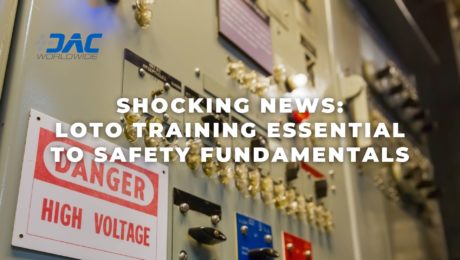
My neighbor asked me to install a new electrical outlet in his master bathroom. He was eventually shocked to learn that I’m not a licensed electrician! OK, that’s an old—and terrible—joke, but it does underscore the importance of safety when it comes to working with electrical current.
In the modern industrial workplace, there are a whole host of skills that workers need to know. No matter how highly skilled a worker might be, however, nothing will matter if the fundamental basics of safety aren’t mastered.
When it comes to safety, one of the most important skills that workers must learn is how to work safely with electricity. According to a FacilitiesNet article by Ashley Beebe, “[w]hen working with electrical distribution systems and components, frontline maintenance technicians and engineers often face the potential for serious injury or death from electrocution or arc flashes, but knowledge of safety tips, procedures, codes and regulations can help technicians and engineers lessen the risk and potential for serious injury or death.”
That’s why, “[a]ccording to the Occupational Safety and Health Administration (OSHA), employees must not work near an electric current, any equipment, or a part they may come in contact with while on the job, unless it has been de-energized. If an electric current has not been de-energized, employees must be protected by isolation, insulation, warning signs or other methods.”
In safety training, the control of hazardous energy is often known by its more popular moniker “lock-out/tag-out or LOTO.” According to OSHA, “[p]roper lock-out/tag-out practices and procedures safeguard workers from hazardous energy releases.” Teaching workers hands-on LOTO skills will help them to understand how to properly control hazardous energy and maintain a safe work environment.
For companies looking to improve their safety training, a thorough review of current training materials is a great place to start. Do employees have access to hands-on training with actual components they’ll encounter on the job? If not, partnering with established companies to provide industrial-quality training systems that will stand the test of time will help ensure the continued safety of the workforce.
For example, DAC Worldwide offers a safety training system specifically designed to give employees the hands-on experience they need to master lock-out/tag-out skills. Be sure to check out DAC Worldwide’s Lock-Out/Tag-Out Training System and contact a DAC Worldwide representative to learn how you can improve your training today!
- Published in News
New Marine Corps Doctrine Promotes Education & Training

Click here to view New Marine Corps Doctrine Promotes Education & Training as a multimedia presentation.
The few. The proud. Who are we talking about? The Marines, of course. That particular recruiting slogan has been permanently etched into our memories over the years.
And it’s a great slogan. The Marines are legendary for a training regimen that weeds out all but the strongest, creating a fighting force to be reckoned with. Indeed, the Marines have been on the front lines of every major U.S. military campaign of the modern era.
To be prepared for the future, however, the Marines know that training the same way they have in the past will not be sufficient. That’s why a recent doctrinal publication puts a new focus on education and continued learning.
Industry, always closely connected to the military, would do well to put a renewed emphasis on education and training, too. In this article, we’ll take a closer look at how partnering with a trusted technical training company like DAC Worldwide can prepare your students, workers, soldiers, and sailors for a bright future.
A New Doctrine for a New Era

According to a Marine Corps Times article, “the Marine Corps unveiled the Marine Corps Doctrinal Publication 7 [MCDP 7] in February [2019] as the service aims to promote education, training, and continued learning among Marines so they become students of their profession.”
How significant was this doctrinal development? MCDP 7 was the first new doctrinal publication issued by the Marines since 2001. Its goal: “to motivate Marines to personally assess where they can improve and understand the ‘why’ behind the significance of learning.”
Maj. Gen. William Mullen was quoted as saying “that he’s heard Marines say they joined the service to escape an academic education. But the Corps wants its personnel to understand that the two complement one another and that education prepares Marines to think quickly when faced with challenges.”
According to Mullen, “You need both training and education. Training prepares you for things you know you’re going to have to do…But the education piece comes in when the unknown starts to happen, which it always does.” Mullen specifically referred to the fact that the environments Marines face today present challenges that are only growing more complex.
This new doctrinal change comes as “Commandant of the Marine Corps Gen. David Berger is working to remake the Corps to better compete with potential high-end adversaries…Berger wants a leaner force to conduct sea denial operations, survive in a contested maritime environment and serve as a larger Naval expeditionary force.”
It’s Not Just the Marines
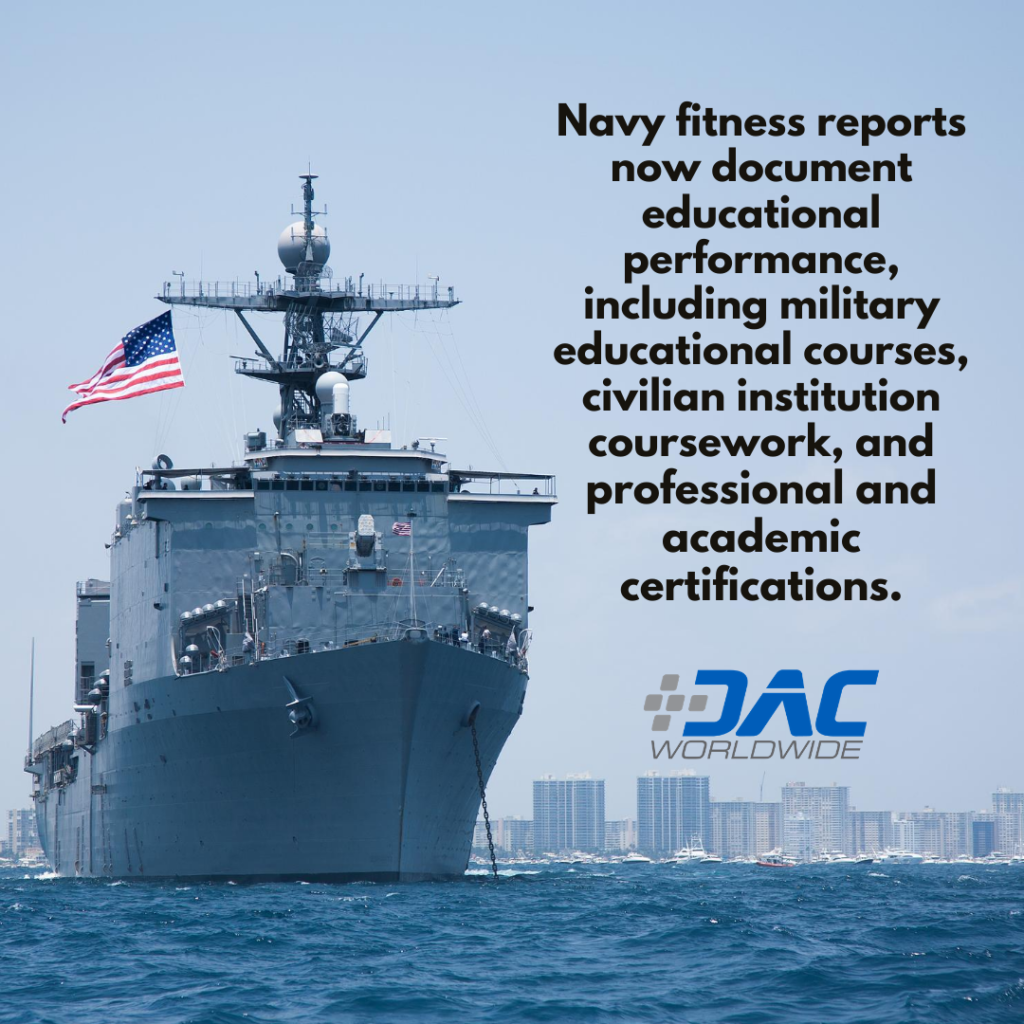
Speaking of the Navy, the Marine Corps Times article notes that the Navy announced in May 2019 “that it was modifying fitness reports to reflect an individual’s educational and training accomplishments, including military education courses, professional and academic certifications, among other things.”
Like the Marines’ new focus on education and continued learning, the Navy’s modified fitness reports are meant to “show that career-long military learning isn’t only job-related technical or tactical training, and that a commitment to higher education will produce Navy leaders with more refined critical thinking skills,” according to an article in the Navy Times.
Future Navy fitness reports will thus document educational performance, including “[m]ilitary educational courses, civilian institution coursework, and professional and academic certifications.” Navy leadership also indicated they will also encourage additional informal efforts, such as learning new technologies.
It’s All COOL
It’s no coincidence that the Marines and the Navy would emphasize professional and academic certifications. Much of the training that military personnel receive prepares them for future civilian jobs.
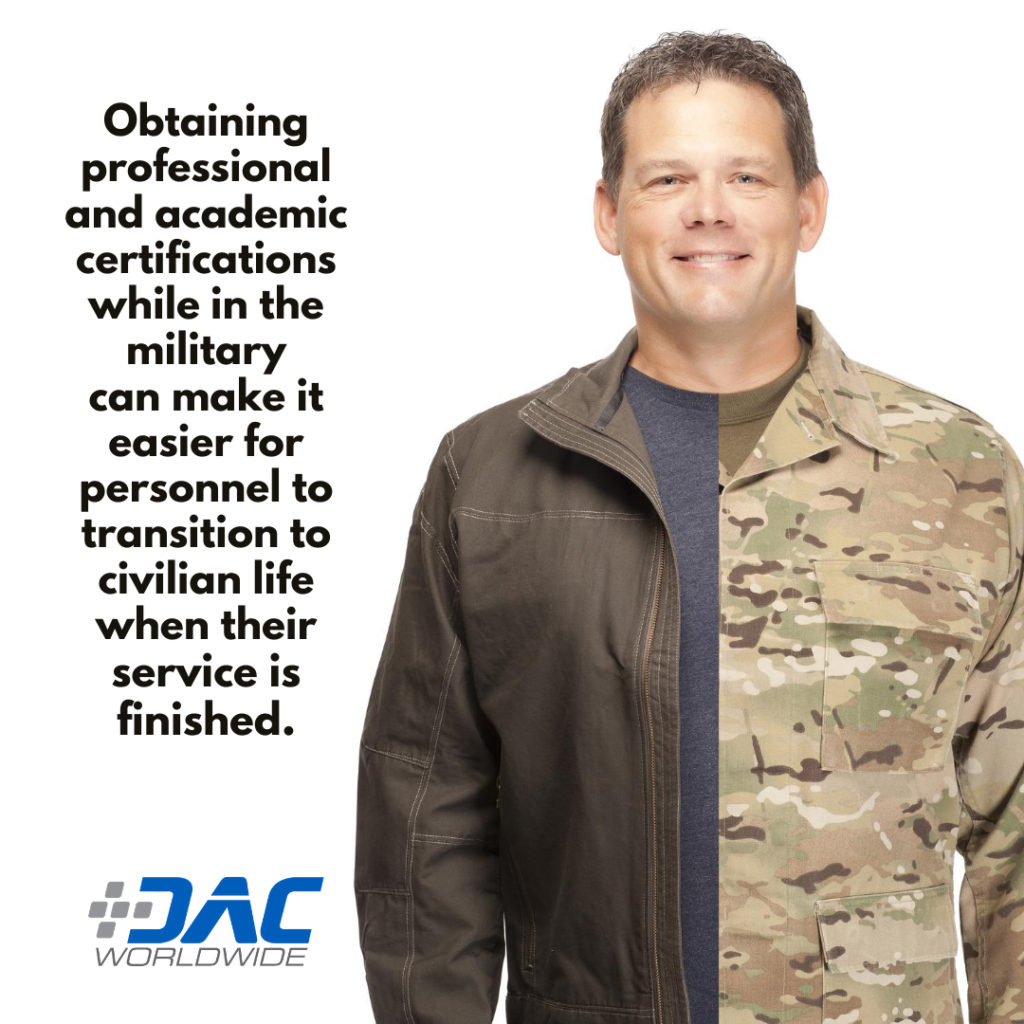
Obtaining professional and academic certifications while in the military can make it easier for personnel to transition to civilian life when their service is finished. All branches of the military recognize the importance of certifications in making that transition as easy as possible.
For example, the Marine Corps COOL site (Marine Corps Credentialing Opportunities On-Line) helps Marines see how their military training and experience matches up with civilian credential requirements. Such credentials could include important and valuable advanced manufacturing credentials from entities like the National Institute of Metalworking Skills (NIMS) and the Manufacturing Skill Standards Council (MSSC).
Marines using the COOL site can see whether military funding is available to help attain particular credentials. They can also see how the training and skills they’ve already acquired might match up with specific credentials valued by employers, such as NIMS’ Industrial Technology Maintenance (ITM) certification or MSSC’s Certified Production Technician (CPT) certification. There are also COOL sites for the Army, Coast Guard, Navy, and Air Force.
Industry Must Also Evolve
Given the military’s new focus on education and continued learning, it’s important that industries that work with and support the military evolve in a similar fashion. The military-industrial complex consists of all sorts of industries that work closely with the military to help them accomplish their mission.
These industries should take a cue from their military counterparts and begin to develop a similar focus on education and continued learning among their workforce. Industry workers will only be able to continue to keep pace with their military counterparts if they’re also seeking new educational opportunities and learning new skills and technologies.
Pushing an industrial workforce or a military organization toward more education and greater skill development can be a daunting task. That’s why it’s imperative that both the military and their industrial counterparts seek out and rely upon the expertise of a trusted technical training partner.
A Trusted Education & Training Partner
DAC Worldwide is a US-based world leader in technical training solutions. For over 35 years, DAC Worldwide has been helping industrial employers and military organizations with realistic, hands-on training systems.
DAC Worldwide offers a wide range of product solutions to fit all your training needs. From training systems that teach a full range of skills to cutaways that increase understanding of how a component works, we have what you need.
For example, many military personnel work in the same skilled occupations as civilians. This means they need a solid foundation in various technologies, including electrical, electronics, fluid power, and mechanical drives.
Whether you train military personnel working on military bases or civilian crews with military contracts, DAC Worldwide’s military training solutions offer an unmatched range of products to allow you to create the course you need or to fill in any gaps that you have in your current training.
Let’s take a closer look at four specific DAC Worldwide products that can take your training program to the next level:
Lock-Out/Tag-Out Training System (811-000)
DAC Worldwide’s Lock-Out/Tag-Out Training System features a realistic, simulated working process environment that facilitates introductory training with hands-on activities related to the process of identifying and locking out sources of dangerous potential energy in an industrial setting. The training system includes two process tanks; a centrifugal pump; a complex, multi-purpose piping network; electrical controls; a variety of lockable system components; and a lock-out/tag-out kit that features a large number of commonly-encountered locking and tagging devices.
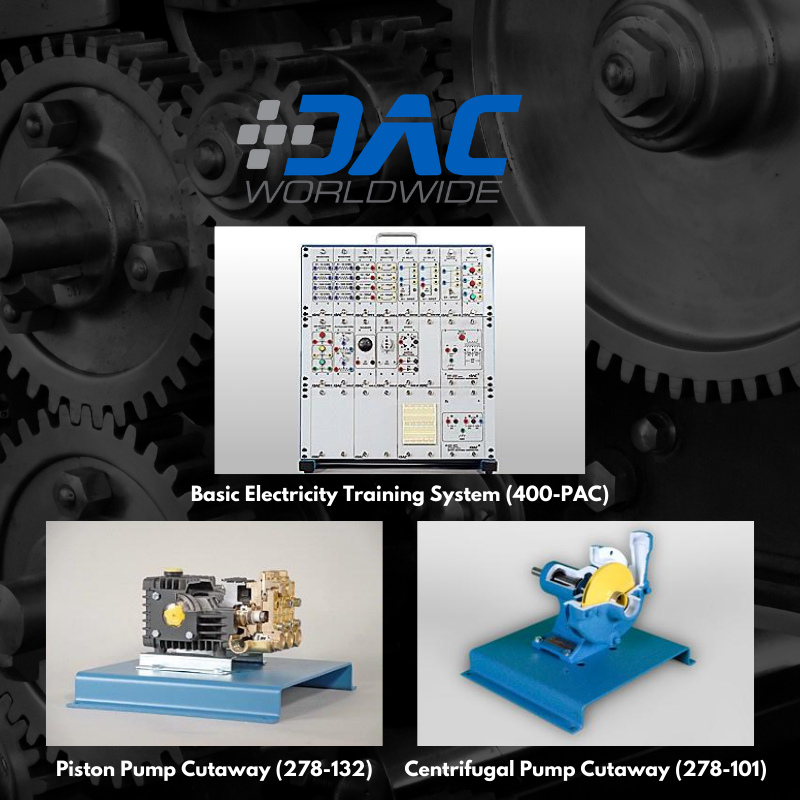
Basic Electricity Training System (400-PAC)
DAC Worldwide’s Basic Electricity Training System teaches basic AC and DC electrical principles. Learners will explore how electricity is used for power and control in various sectors. The trainer covers industry-relevant skills, such as installing, operating, and troubleshooting AC and DC electrical circuits in a variety of applications.
Piston Pump Cutaway (278-132)
DAC Worldwide’s Piston Pump Cutaway is an industrial piston pump that has been carefully sectioned and color-coded to train learners in the design, operation, construction, and maintenance of this common process pump used throughout industry. The cutaway exposes and showcases the complete internal configuration of an industrial piston pump. Moreover, seal features and bearings have been retained to allow realistic, hands-on pump maintenance and operation training.
Centrifugal Pump Cutaway (278-101)
DAC Worldwide’s Centrifugal Pump Cutaway is a sectioned centrifugal pump that provides realistic training in the operating principles, construction details, and maintenance of common centrifugal process pumps used throughout industry and the military. It includes various sectioned components, such as seals and bearings, as well as showcasing the pump’s impeller.
Contact DAC Worldwide Today
Is your organization ready to take its industrial technical training to the next level? Contact a DAC Worldwide expert today for a personal consultation regarding your training needs and how our variety of training systems, cutaways, dissectibles, and models can prepare both industrial workers and military personnel for the future challenges they face.

- Published in News


