


New Marine Corps Doctrine Promotes Education & Training
Click here to view New Marine Corps Doctrine Promotes Education & Training as a multimedia presentation.
The few. The proud. Who are we talking about? The Marines, of course. That particular recruiting slogan has been permanently etched into our memories over the years.
And it’s a great slogan. The Marines are legendary for a training regimen that weeds out all but the strongest, creating a fighting force to be reckoned with. Indeed, the Marines have been on the front lines of every major U.S. military campaign of the modern era.
To be prepared for the future, however, the Marines know that training the same way they have in the past will not be sufficient. That’s why a recent doctrinal publication puts a new focus on education and continued learning.
Industry, always closely connected to the military, would do well to put a renewed emphasis on education and training, too. In this article, we’ll take a closer look at how partnering with a trusted technical training company like DAC Worldwide can prepare your students, workers, soldiers, and sailors for a bright future.
A New Doctrine for a New Era
 According to a Marine Corps Times article, “the Marine Corps unveiled the Marine Corps Doctrinal Publication 7 [MCDP 7] in February [2019] as the service aims to promote education, training, and continued learning among Marines so they become students of their profession.”
How significant was this doctrinal development? MCDP 7 was the first new doctrinal publication issued by the Marines since 2001. Its goal: “to motivate Marines to personally assess where they can improve and understand the ‘why’ behind the significance of learning.”
Maj. Gen. William Mullen was quoted as saying “that he’s heard Marines say they joined the service to escape an academic education. But the Corps wants its personnel to understand that the two complement one another and that education prepares Marines to think quickly when faced with challenges.”
According to Mullen, “You need both training and education. Training prepares you for things you know you’re going to have to do…But the education piece comes in when the unknown starts to happen, which it always does.” Mullen specifically referred to the fact that the environments Marines face today present challenges that are only growing more complex.
This new doctrinal change comes as “Commandant of the Marine Corps Gen. David Berger is working to remake the Corps to better compete with potential high-end adversaries…Berger wants a leaner force to conduct sea denial operations, survive in a contested maritime environment and serve as a larger Naval expeditionary force.”
 It’s Not Just the Marines
Speaking of the Navy, the Marine Corps Times article notes that the Navy announced in May 2019 “that it was modifying fitness reports to reflect an individual’s educational and training accomplishments, including military education courses, professional and academic certifications, among other things.”
Like the Marines’ new focus on education and continued learning, the Navy’s modified fitness reports are meant to “show that career-long military learning isn’t only job-related technical or tactical training, and that a commitment to higher education will produce Navy leaders with more refined critical thinking skills,” according to an article in the Navy Times.
Future Navy fitness reports will thus document educational performance, including “[m]ilitary educational courses, civilian institution coursework, and professional and academic certifications.” Navy leadership also indicated they will also encourage additional informal efforts, such as learning new technologies.
 It’s All COOL
It’s no coincidence that the Marines and the Navy would emphasize professional and academic certifications. Much of the training that military personnel receive prepares them for future civilian jobs.
Obtaining professional and academic certifications while in the military can make it easier for personnel to transition to civilian life when their service is finished. All branches of the military recognize the importance of certifications in making that transition as easy as possible.
For example, the Marine Corps COOL site (Marine Corps Credentialing Opportunities On-Line) helps Marines see how their military training and experience matches up with civilian credential requirements. Such credentials could include important and valuable advanced manufacturing credentials from entities like the National Institute of Metalworking Skills (NIMS) and the Manufacturing Skill Standards Council (MSSC).
Marines using the COOL site can see whether military funding is available to help attain particular credentials. They can also see how the training and skills they’ve already acquired might match up with specific credentials valued by employers, such as NIMS’ Industrial Technology Maintenance (ITM) certification or MSSC’s Certified Production Technician (CPT) certification. There are also COOL sites for the Army, Coast Guard, Navy, and Air Force.
 Industry Must Also Evolve
Given the military’s new focus on education and continued learning, it’s important that industries that work with and support the military evolve in a similar fashion. The military-industrial complex consists of all sorts of industries that work closely with the military to help them accomplish their mission.
These industries should take a cue from their military counterparts and begin to develop a similar focus on education and continued learning among their workforce. Industry workers will only be able to continue to keep pace with their military counterparts if they’re also seeking new educational opportunities and learning new skills and technologies.
Pushing an industrial workforce or a military organization toward more education and greater skill development can be a daunting task. That’s why it’s imperative that both the military and their industrial counterparts seek out and rely upon the expertise of a trusted technical training partner.
A Trusted Education & Training Partner
DAC Worldwide is a US-based world leader in technical training solutions. For over 35 years, DAC Worldwide has been helping industrial employers and military organizations with realistic, hands-on training systems.
DAC Worldwide offers a wide range of product solutions to fit all your training needs. From training systems that teach a full range of skills to cutaways that increase understanding of how a component works, we have what you need.
For example, many military personnel work in the same skilled occupations as civilians. This means they need a solid foundation in various technologies, including electrical, electronics, fluid power, and mechanical drives.
Whether you train military personnel working on military bases or civilian crews with military contracts, DAC Worldwide’s military training solutions offer an unmatched range of products to allow you to create the course you need or to fill in any gaps that you have in your current training.
Let’s take a closer look at four specific DAC Worldwide products that can take your training program to the next level:
Lock-Out/Tag-Out Training System (811-000)
DAC Worldwide’s Lock-Out/Tag-Out Training System features a realistic, simulated working process environment that facilitates introductory training with hands-on activities related to the process of identifying and locking out sources of dangerous potential energy in an industrial setting. The training system includes two process tanks; a centrifugal pump; a complex, multi-purpose piping network; electrical controls; a variety of lockable system components; and a lock-out/tag-out kit that features a large number of commonly-encountered locking and tagging devices.
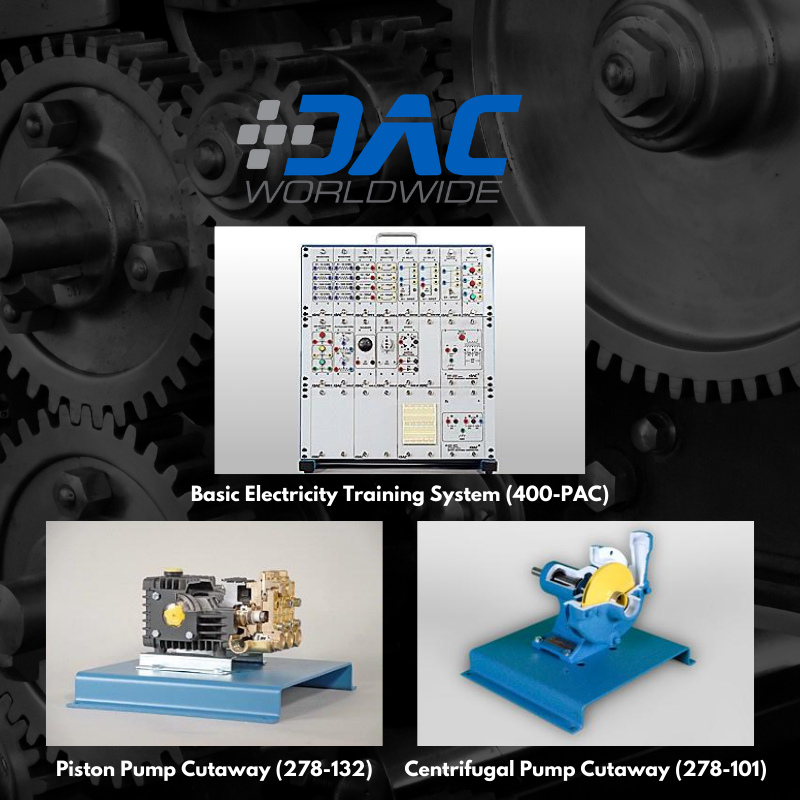 Basic Electricity Training System (400-PAC)
DAC Worldwide’s Basic Electricity Training System teaches basic AC and DC electrical principles. Learners will explore how electricity is used for power and control in various sectors. The trainer covers industry-relevant skills, such as installing, operating, and troubleshooting AC and DC electrical circuits in a variety of applications.
Piston Pump Cutaway (278-132)
DAC Worldwide’s Piston Pump Cutaway is an industrial piston pump that has been carefully sectioned and color-coded to train learners in the design, operation, construction, and maintenance of this common process pump used throughout industry. The cutaway exposes and showcases the complete internal configuration of an industrial piston pump. Moreover, seal features and bearings have been retained to allow realistic, hands-on pump maintenance and operation training.
Centrifugal Pump Cutaway (278-101)
DAC Worldwide’s Centrifugal Pump Cutaway is a sectioned centrifugal pump that provides realistic training in the operating principles, construction details, and maintenance of common centrifugal process pumps used throughout industry and the military. It includes various sectioned components, such as seals and bearings, as well as showcasing the pump’s impeller.
Contact DAC Worldwide Today
Is your organization ready to take its industrial technical training to the next level? Contact a DAC Worldwide expert today for a personal consultation regarding your training needs and how our variety of training systems, cutaways, dissectibles, and models can prepare both industrial workers and military personnel for the future challenges they face.

- Published in News