


Recognizing Red Flags: Training Workers to Prioritize Safety
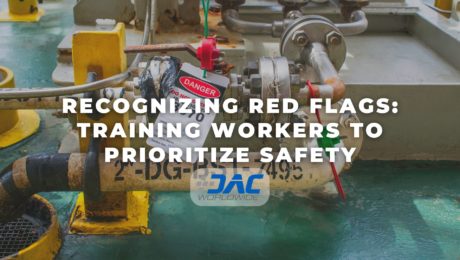
Do you keep an eye out for red flags? If you’re still looking for that someone special, you might see red flags when their online dating profile indicates they’re unemployed and still living in their parents’ basement.
But those aren’t the red flags we’re talking about in this article. Red flags signify danger. They’re warning signs, and today’s workers need to recognize them in the workplace. Why? Their safety and wellbeing depends upon it.
Workplace safety remains a critical component of any industry’s success, yet it too frequently doesn’t get the attention it deserves. New technologies and the latest and greatest advances tend to capture the most attention, but the basics of safety can bring everything to a grinding halt if they’re ignored.
In this article, we’ll take a look at five red flags that workers must learn to recognize in order to make safety a top priority. We’ll also explain the importance of safety training and how the training tools offered by DAC Worldwide can help workers learn the skills that will keep them safe in the modern workplace.
5 Safety Red Flags Employees Must Learn to Recognize
How important is worker safety in your workplace? According to an IndustryWeek article by Matt Thiel and Dan Idzikowski, “nearly all [manufacturers] will say [safety is] a top priority…At the same time, the features and processes intended to keep people safe are rarely put to the test until a crisis occurs. It’s only when safety fails — when there is an injury or a near-miss — that companies question whether they are doing enough to protect workers.”
Modern industrial workplaces feature a wide variety of safety features designed to keep workers safe. Yet, workplace injuries remain a serious problem. For example, “more than 420,000 manufacturing workers were injured on the job in 2019, according to the U.S. Bureau of Labor Statistics, accounting for 15% of all nonfatal injuries in the private sector that year.”
What can be done to improve workplace safety? According to Thiel and Idzikowski, “[s]afety planning starts by imagining the unimaginable…it’s critical to play devil’s advocate and ask what could happen that shouldn’t, and how both the equipment and the operator will respond if it does.”
Once safety risks are identified, workers must be trained to recognize situations in which particular care must be taken to avoid injury. Otherwise, “[w]hen safety is treated as an afterthought, it’s only a matter of time until a preventable accident happens.” Here are five specific red flags Thiel and Idzikowski belive workers must learn to recognize:
- Access: Workers must learn to recognize situations in which “[o]perators can access hazardous areas while the hazard is present. Systems that require hands-on operator involvement…have built-in risks…Making these systems safe may mean containing the hazard behind guards or designing the machine so it won’t run until the operator is clear. Whether the danger is readily apparent, like moving parts, or invisible, like electrical current, the best safeguards make it impossible for the operator to even get near.”
- Rules: Workers should be on high alert for situations in which “[p]eople are bypassing the rules.Safety depends on people choosing to follow the rules…Even well-trained people can be lulled into a false sense of security and start taking shortcuts to make work faster or easier…If people are looking for ways around a safety system, it’s probably not well aligned with the operation. Rather than disabling the mechanism or retraining the operators, analyze the entire system and find a way to marry safety with the way the process really works.”
- Alarms: Workers need to notify management when “[a]larm systems don’t distinguish between emergencies and non-emergencies…if the system treats everything like an emergency, workers will treat nothing like an emergency. Frequent false alarms will lead workers to ignore the warning signs or circumvent them.”
- Obsolete: Workers must learn to keep an eye out for “[s]afety features [that] are outdated.A test of older fail-safes may find they no longer work — if they ever did in the first place…Maintaining a safe work environment means ongoing risk assessment. Safety professionals should perform regular audits of the equipment on the shop floor and keep an eye out for advancements that could make it safer.”
- Routine: Workers should alert management when they notice that “[s]afety features are not regularly tested and validated…the systems that keep workers safe should be checked on a regular basis.”
If workers can learn to recognize these five red flags, safety will become a higher priority and everyone in the workplace will benefit. As Thiel and Idzikowski acknowledge, “[t]he return on investment in safety is hard to measure. If a company invests millions in safety upgrades and there are no near-misses, was it a waste of money or did the upgrades do their job? A better question is what might realistically happen without safety upgrades.”
Safety Training: Begin with the Basics
Basic safety procedures are essential to keeping employees from becoming injured on the job. While manufacturing jobs can be dangerous, instituting safety procedures and ensuring that employees are properly trained are critical steps that employers must take to minimize the risk of injuries or death.
Not only does proper safety training reduce the number of workplace injuries, but it also adds to a company’s bottom line by improving productivity and reducing downtime caused by employees who can’t work when injured. But where should an employer start? How about at the beginning?
One of the most basic—and important—areas to focus on is the control of hazardous energy, often known by its more popular moniker “lockout/tagout.” According to the United States Department of Labor’s Occupational Safety and Health Administration (OSHA), “[e]nergy sources including electrical, mechanical, hydraulic, pneumatic, chemical, thermal, or other sources in machines and equipment can be hazardous to workers. During the servicing and maintenance of machines and equipment, the unexpected startup or release of stored energy can result in serious injury or death to workers.”
“Workers servicing or maintaining machines or equipment may be seriously injured or killed if hazardous energy is not properly controlled…Injuries may include electrocution, burns, crushing, cutting, lacerating, amputating, or fracturing body parts… Craft workers, electricians, machine operators, and laborers are among the millions of workers who service equipment routinely and face the greatest risk of injury.”
Fortunately, “[p]roper lockout/tagout (LOTO) practices and procedures safeguard workers from hazardous energy releases.” Teaching workers hands-on LOTO skills will help them to understand how to properly control hazardous energy and maintain a safe work environment.
DAC Worldwide Offers Superior LOTO Training
For companies looking to improve their safety training, a thorough review of current training materials is a great place to start. Do employees have access to hands-on training with actual components they’ll encounter on the job? If not, partnering with established companies to provide industrial-quality training systems that will stand the test of time will help ensure the continued safety of the workforce.
Employers don’t need to recreate the wheel to move toward a skills-based approach to hiring. DAC Worldwide, an industry-leading manufacturer of technical assessment and training tools, offers a variety of solutions to the problems employers face.
For example, DAC Worldwide offers a safety training system specifically designed to give employees the hands-on experience they need to master lockout/tagout skills. DAC Worldwide’s Lock-Out/Tag-Out Training System (811-000) features a realistic, simulated working process environment that facilitates introductory training with hands-on activities related to the process of identifying and locking out sources of dangerous potential energy in an industrial setting.
Since technical training is most effective when learners can gain hands-on practice with industry-standard components they’ll encounter on the job, the Lock-Out/Tag-Out Training System features a wide variety of common, industrial-quality components to provide learners with a realistic training experience that will build skills that translate easily to the workplace.
For example, the Lock-Out/Tag-Out Training System features:
- two PVC process tanks with removable covers, vents, drains, and process connections;
- PVC process network with block valves, 3-way valves, figure-8 blinds, and descriptive valve tags;
- fractional HP magnetic drive centrifugal pump;
- drain collection and distribution tubing network with valved central collection manifold;
- electrical controls, with provision for lock-out, including primary service disconnect, motor starter switch, in-line GFI protector, and system plug connection; and
- a comprehensive lock-out/tag-out tool kit with color-coded locks, tags, multi-lock hasps, specialty electrical locking devices, valve locking devices of multiple designs, and a dedicated toolbox.
The Lock-Out/Tag-Out Training System’s courseware consists of a training manual and hands-on exercises. These can be used as part of either an instructor-led course or self-directed study. A final performance assessment exercise is also provided, allowing the system to be used in an alternate configuration for testing purposes.
Contact a consultant with DAC Worldwide today to learn more about how their technical training tools can help you build the assessment and training program your company needs. Using DAC Worldwide training and assessment tools, you can transition to a skills-based hiring approach and fill the skills gaps in your organization!
- Published in News